In class today, we spent a lot of time deconstructing Generative AI. As I prepare to become a teacher, I’ve been thinking a lot about how I can use these AI tools responsibly without losing the human touch that I value in teaching.
What I See as the Major Limitations of GenAI
When I look at and use GenAI, I see a few red flags that I have to keep in mind:
- I worry about misinformation. I’ve noticed that AI can be incredibly confident while being completely wrong. In a science context, I need to be aware of its ability to make mistakes. I can’t risk giving my students fabricated data, false information, or fake citations.
- I am concerned about inherent bias: I recognize that these models are trained on data that often carries societal biases. I feel a responsibility to ensure the materials I give my students don’t quietly reinforce common stereotypes.
- I want to enforce critical thinking. I think teaching students how to use AI is necessary nowadays, but I am worried that with this comes the decrease in their critical thinking skills. I have to be wary whilst teaching this, and foster their critical thinking skills throughout (ex: ensure they look over the generated material to make sure it is correct).
- I am mindful of the ethical footprint and privacy concerns: AI is quite controversial when it comes to the environmental impact it has and the use of personal data. I need to make sure I am keeping this at the forefront of my mind when it comes to using AI.
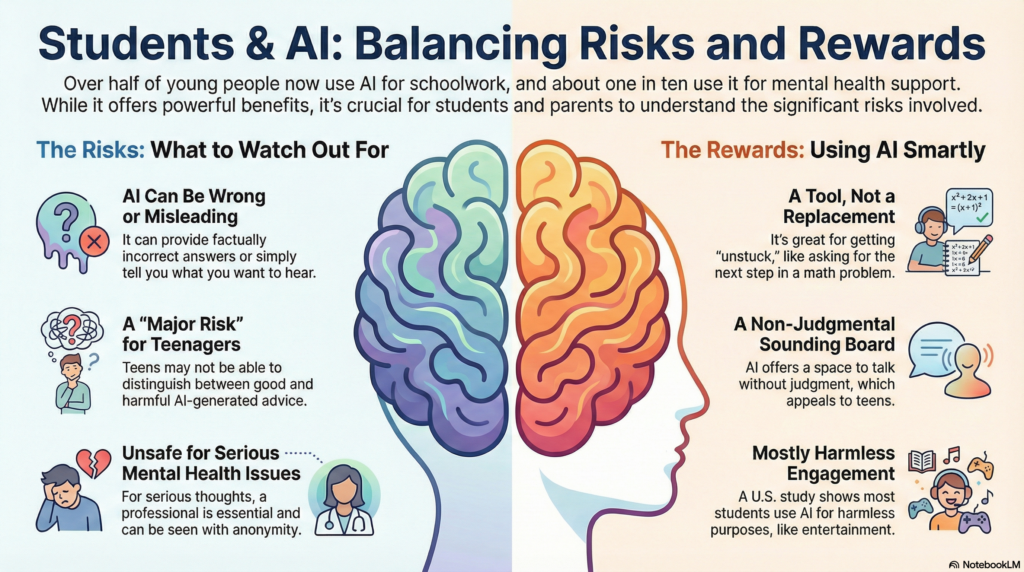
Below I asked NotebookLM to make me an infographic about the risks and benefits of AI on students. I found this was a very cool tool that I can see myself using in the future. This is what it produced.
How I Plan to Use AI in My Classroom
As I look forward to teaching upper-level Biology and Environmental Science, I’ve brainstormed a few ways I want to integrate AI:
- Diversifying Explanations: Biology can be incredibly dense. I plan to use AI to help me translate complex topics (like the Krebs cycle or DNA replication) into different reading levels and different levels of understanding so I can better support every student in my room.
- Generating Case Studies: I love using real-world scenarios. I can ask AI to “Write a 300-word case study about a fictional BC town facing a sudden decline in salmon populations” for my students to troubleshoot and unpack.
- Simplified Summaries: If I find a complex scientific paper that is too dense for Grade 12, I’ll use AI to “Summarize this article into five bullet points at a 12th-grade reading level.”
- Infinite Practice Problems: If a student is struggling with a specific concept like balancing chemical equations or solving for x, I can instantly generate 10 more practice problems that are exactly at their current difficulty level.
- Scaffold Math in Science: For my lower-level math and science students, I hope to use AI to generate step-by-step practice problems that adapt to where they are struggling, helping them build confidence before we move to more abstract concepts.
- There are so many ways to use AI.
My Personal Experience with GenAI so far
I have already started playing around with AI for my own prep work. The models I find helpful is Claude and Gemini . Using these tools, I’ve found a mix of results:
- I’ve found it incredibly useful for lesson plans: When I’m stuck on how to start a lesson plan or need different ideas for a lab activity, I find that AI is a great brainstorming partner.
- I’ve used it to build rubrics and tests: It saves me so much time when creating the initial draft of a rubric or a set of multiple-choice questions for a test.
- I’ve realized I still need to be the expert: Even when the AI gives me a worksheet or an assignment, I find I always have to go in and tweak the language to make sure it matches my teaching style and the BC Curriculum.
Ultimately, I want to use AI to make my teaching easier and reduce the amount of repetitive tasks that often lead to teacher burnout. By streamlining things like making rubric drafts, email templates, and basic worksheet generation, I can protect my time and energy for what truly matters: building authentic relationships with my students, developing creative hands-on labs, and focusing on my own professional growth as an educator. I believe that if I can spend less time staring at a gradebook or a blank lesson plan, I can spend more time being an engaged and present teacher in the classroom.