
Our Inquiry
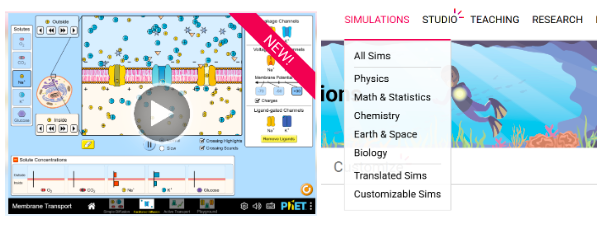
Our group is wondering how online lab simulations (like PhET Simulations) compare to in-person lab learning opportunities in science classrooms, and if they can be an effective tool in science and math classrooms. We are analyzing advantages and disadvantages of online simulations and comparing them to that of in person, traditional lab activities. We are also looking into a few specific PhET simulations (PhET Interactive Simulations, 2022). and comparing them to equivalent in lab activities. Finally, we are interested in the visual arts side of simulations and curious about the benefits of visual learning in a case like this. Shown below is a screenshot of the wide variety of labs offered by PhET, which we will be referring to throughout our project.
Anna-Maria: Comparative Analysis
For my portion of our Tech Ed Inquiry, I am seeking to analyze specific comparisons between PhET simulations and traditional, in-person lab experiences for Biology, Chemistry, and Physics. PhET offers a wide variety of virtual interactive lab simulations for all three subjects, which focus primarily on modeling concepts, demonstrating scientific laws, or enabling students to manipulate variables and observe the consequences thereof. Below, I have included an example of the comparative analysis I have been conducting between PhET labs and classic in-person labs. My hope is that this comparative analysis will aid in determining whether the PhET labs could be put forward as an effective tool for students learning these subjects.
| PhET: Membrane Transport Simulation | Both | Potato Osmosis In-Person Lab |
| Demonstrates diffusion and ion movement at a molecular level but does not directly demonstrate osmosis Does not require extensive materials, preparation, or multi-day laboratory time Removes aspects of equipment or human error | Demonstrates changes in membrane permeability and laws molecule movement Allows students to observe tangible aspects of cell theory relating to membrane transport Enables students to change external variables and observe the consequences | Demonstrates diffusion and osmosis (movement of water), but does not depict other ion movement Enables students to learn the effects of bias, equipment choice, and human error on results Requires students to practice calculations and use deductive reasoning to decipher results |
The next steps in my research include continuing this comparative analysis for the remainder of the labs I’ve chosen across three subject areas. My goal is that this analysis will let be compile a list of PhET labs that could be put forward as part of our presentation as positive candidates for replacing or supplementing commonly used in-person labs, in addition to a list of in-person labs that cannot be replaced by interactive simulations, the reasons for which will be further explained and supported by Aby’s and Keira’s research concerning advantages and disadvantages of both physical and simulation labs.
Aby: Physical Lab Work
For my portion of the project, I am looking into the benefits and the drawbacks of physical, in-class lab work. So far in my research, I have been focusing on the pros, or the benefits, of doing lab experiments in the classroom. Some of the benefits I thought of and found (Pedretti & Bellomo, 2014) and are as follows:
- Hands on Learning/Engagement
Hands-on learning is a huge benefit for physical labs. Working with new materials is exciting and engages students. Hands on work also appeals to the kinesthetic students that learn better by doing. In class lab work also creates fun memories, especially when an experiment has an exciting reaction or finding.
- Technical and Practical Skills
In-class labs help build competence with lab equipment and measurement tools, which will be useful especially if they decide to go into post-secondary or technical careers. It also will help develop fine motor skills and teach them proper safety protocols and risk assessment.
- Collaboration and Communication
Physical lab experiments often require groupwork. This will encourage teamwork and help them learn how to divide the labour. It will help with students’ verbal communication through discussion and also builds written communication through lab reports.
- Discovery and Curiosity
Hands-on work allows students to witness phenomena and natural processes firsthand rather than just reading about them. It also sparks curiosity and encourages questions and deeper investigation. Most importantly, it makes science feel real and relevant to everyday life. The next step in my research will be diving into the cons, or the drawbacks, of physical lab work.
Keira: Lab Simulations
I was excited to look into the advantages and disadvantages of using simulations in the science classroom. There were a few advantages that I knew from my high school days and attending university during COVID. For example, safety concerns are relatively non-existent in online simulations, and there are increases in conceptual clarity, especially within processes that are really tiny or really big and impossible to replicate meaningfully. I also found some disadvantages in a text book (Pedretti & Bellomo, 2014) that I used for my science methods course last semester. Students do not develop the skills required to manipulate lab materials, or practice the safety required to obtain successful results. Next steps for this line of research involve diving deeper into pros and cons of simulations in the science classroom.
Kelly: A Visual Arts Approach
From a visual arts perspective, online lab simulations offer powerful opportunities for visual learning. Platforms like PhET Interactive Simulations use colour, animation, spatial relationships and interactive design to make the more abstract science concepts more accessible, visible and dynamic. Visual simulations can zoom in on microscopic processes, slow down reactions or visually isolate variables, which traditional labs sometimes cannot do.
When looking at visual literacy, learners are able to interpret meaning through imagery, movement and design elements. Thoughtful use of composition can help guide attention and reduce cognitive load. This is especially good for visual learners – which we all are – as there is a deeper conceptual understanding and engagement in the activity.
From an arts lens, the strength of these simulations is because of the intentional visual design, and it’s clear that aesthetics and clarity are greatly considered and aid in supporting scientific understanding rather than replacing the hands-on experience. We also know that any arts-integrated learning and instruction has a positive effect (Bobek & Tversky, 2016). on memory of scientific content, which suggests that visual/artistic approaches to learning can strengthen the learning outcomes (Hardiman et al., 2019).
References
Bobek, E., Tversky, B., (2016). Creating visual explanations improves learning. Cognitive Research: Principles and Implications, 1 (27). https://doi.org/10.1186/s41235-016-0031-6
Hardiman, M. M., JohnBull, R. M., Carran, D. T., & Shelton, A. (2019). The effects of arts-integrated instruction on memory for science content. Trends in Neuroscience and Education, 14, 25–32. https://doi.org/10.1016/j.tine.2019.02.002
Pedretti, E., & Bellomo, K. (2014). Explorations in Secondary School Science.
PhET Interactive Simulations: University of Colorado Boulder (2022). Simulations. https://phet.colorado.edu/en/simulations/filter?type=html