More Than Fun: Reflecting on Games and Computational Thinking in Science Education
This week’s class got us thinking about how games can be used in classrooms. We explored how online games can go beyond a fun activity and actually serve as intentional teaching tools. I find when I play a game or do an activity based on the content I am learning, I am way more excited and engaged in the learning.
This post will talk on what we explored today. How we can use games and coding as intentional teaching tools in a high school science context, and why both have a real place in the classroom.
My Vibe Coding Project: Orca Run
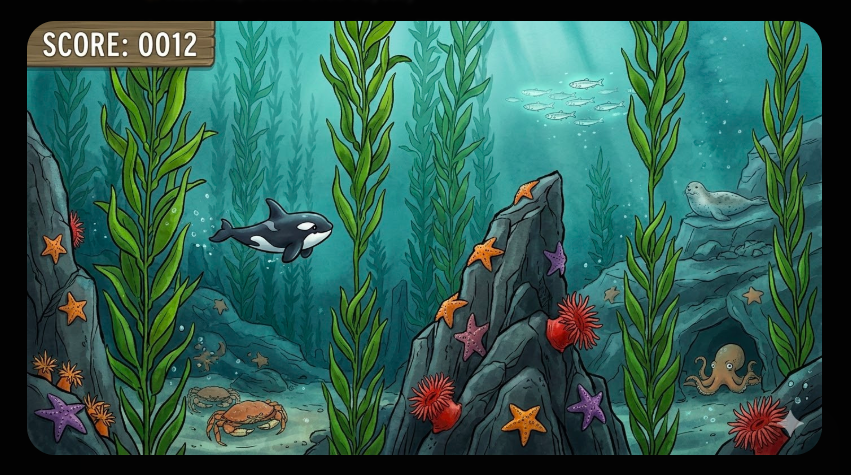
Using Google Gemini, I built a Flappy Bird–style game set in the Pacific Northwest marine ecosystem. Instead of a bird, you guide an orca through the ocean, weaving past rocks, kelp, boats, and other obstacles. The world is populated with other local species you’d actually find off our coast, like harbour seals, Dungeness crab, giant Pacific octopus, and more.
The idea originally came from Rich’s Flappy bird game, but I wanted to wrap local ecology content inside something students actually want to interact with. A student who plays this game for five minutes has passively absorbed something about what an orca shares its habitat with and some environmental obstacles it faces. Below is a screen grab of the game Gemini created for me! It is so cute, and surprisingly accurate.
Why Coding Belongs In A Science Class
Science and coding are more connected than most high school curricula let on. Data collection, modeling, simulation, and statistical analysis all involve code in real research contexts. If students plan to go into science post-secondary, they will encounter a lot of programming. Getting comfortable with computational thinking early removes a barrier that might trip them up later in life. Also, coding develops exactly the same habits that science requires, like breaking problems into smaller parts, testing hypotheses, solcing problems, etc. Those aren’t just coding skills, they’re science skills.
Gaming As A Learning Tool
Games increase engagement in the classroom, make content more memorable, and give students a reason to care about what they’re learning. They create a low-stakes space to fail and try again, which is exactly the mindset good science requires. A game without framing is just entertainment, but when it is paired with a lesson or some guiding questions, it becomes a really great learning tool. The goal isn’t to replace regular learning strategies, but instead intice students to look forward to lessons.
Games and coding aren’t distractions from real learning, they’re entry points into it. As teachers, the opportunity is to be intentional about how we use these tools, so the fun and the learning happen at the same time.